You are here: Home Campaigns Forests Planned burns and vegetation clearing will not stop catastrophic fire events: report
Email to friend Print this page
Updated: September 09, 2009
Regions:
Victoria
Campaigns:
Forests

Planned burns and vegetation clearing will not stop catastrophic fire events: report

The Wilderness Society Archive - This page is over one year old. Links and content may no longer be accurate.

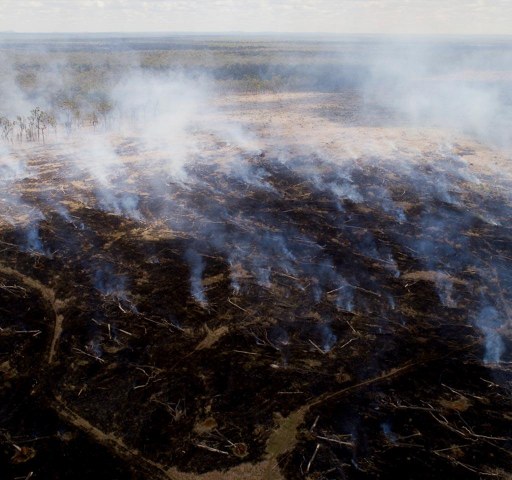
Prescribed burns did not significantly slow the spread of bushfire in the catastrophic conditions of Black Saturday, states a new report released on 10 September 2009.

The report, commissioned by the Australian Conservation Foundation (ACF), the Wilderness Society and the Victorian National Park Association (VNPA), analyses the driving influences of the February 7 fires and looks at how the fires passed through and affected different areas of land. The report has been submitted to the Royal Commission on 10 September 2009. Download the full report here (PDF 6.2MB) >>

cover-2009-bush-fire-report-300.jpg
Cover of February 2009 Victorian Fire Report - by Chris Taylor. Click image to download full report (PDF 6.2 MB)
Report Conclusions;

A number of key issues and observations are made in this report that are relevant to the Royal Commission’s investigation on land management for the protection of life, property and the environment:

  • Most fires started on private land,
  • The area burnt across Victoria comprised state forests (43 per cent), timber plantations (5 per cent), private land (29 per cent) and National Parks (23 per cent).
  • Fires that started on private or leased land on 7 February were uncontrollable by the time they arrived at the boundaries of National Parks (e.g. Kinglake and Yarra Ranges).
  • Fires that started within parks and protected areas (e.g. Wilson’s Promontory and Mt Riddell in Yarra Ranges National Park) were mostly contained within National Parks; the exception being the fire in the Bunyip State Park
  • The condition of vegetation plays a significant role in the intensity and spread of fire (i.e. there is evidence fire spreads more readily in modified and disturbed vegetation)
  • Climate change is likely to be having a significant influence on droughts, maximum temperatures, the low moisture content of fuel, decreased humidity levels and an important contributing factor in the unprecedented maximum temperatures on 7 February 2009
  • The number of high, very high, extreme and catastrophic fire danger days is predicted to increase under climate change
  • The number of extreme fire danger days already exceeds those predicted to occur in 2050
  • The probability of previous prescribed burns slowing a head fire significantly decreases with increasing FFDI
  • On 7 February many areas of forest that had been treated with prescribed burns were still severely burnt because of the extreme conditions

 
It is recommended that the Royal Commission, fire management agencies and the community consider the above aspects of land management for fire risk, and the implications for the appropriate and effective use in mitigating bushfire risk. Reliance on any one method of fire management and/or focusing on one land tenure type could increase risk, particularly given the observations and predictions being made with the increasing intensity and frequency of fire danger days under climate change scenarios.

Download the full report here (PDF 6.2MB) >>


Further reading

Summary and implications of Report: Victorian 2009 February Fires
Article - 10 September 2009
This summary and discussion of the implications of the report has been compiled by the conservation groups. The Report it refers to analyses the driving influences of the February 7 fires and looks at how the fires passed through and affected different areas of land. More >>

Joint Media Release
10 September 2009
Planned burns and vegetation clearing will not stop catastrophic fire events: report. More >>


For more information, please contact:

Fire Project Officer

The Wilderness Society Victoria Inc

288 Brunswick St
Fitzroy, Vic, 3065
Phone: 03 9038 0888

Document Actions


Tasmania's Tarkine forest is under siege by the mining industry.
Please help us to take on the mining industry and protect the Tarkine.


×
Log in