|
Updated: June 14, 2011
|
|
|
|
Advice: Aboriginal and Torres Strait Islander viewers are advised that this website may contain images, names and voices of people who have died.
WildCountry and Aboriginal Australia
A continental and transcultural view of the Australian environment

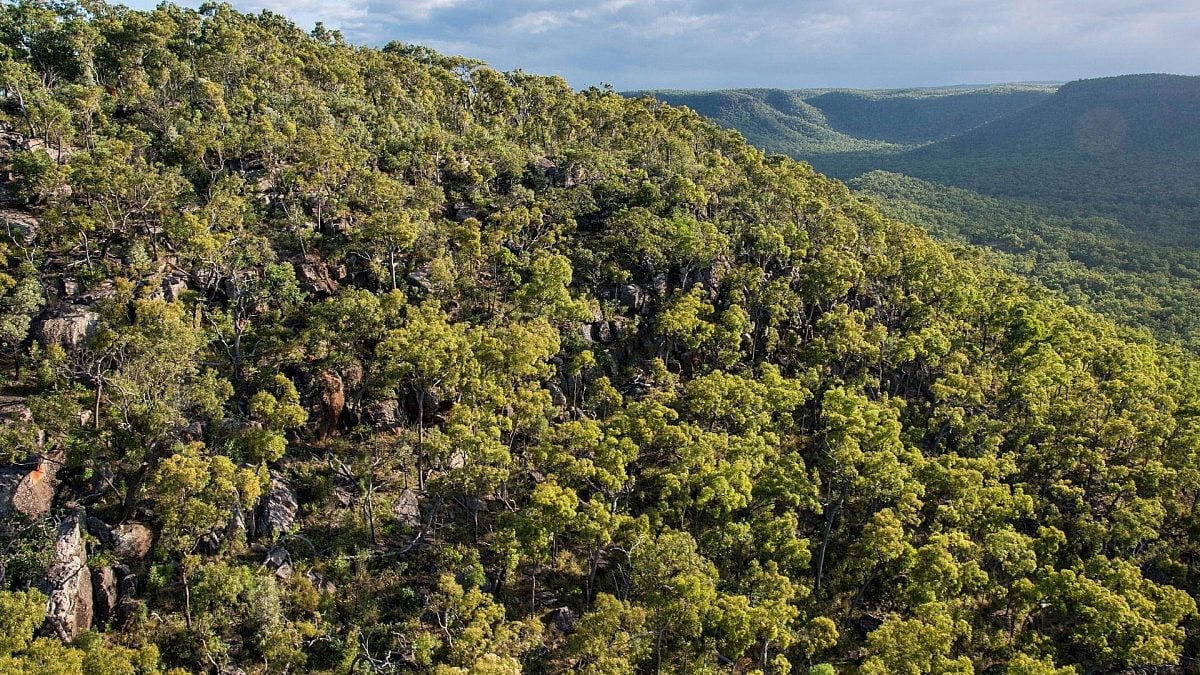
- Mark Sutton, guide and Traditional Owner of Mutawintji National Park in Far Western NSW, points out a geological feature in the distance. Mutawintji is an Aboriginal name which means 'place of green grass and waterholes'. Photo: TWS Photo collection.
WildCountry is addressing global and continental conservation imperatives and recognising the important relationship between conservation, Aboriginal lands and the rights and responsibilities of Indigenous people.
Leading-edge conservation science is very valuable in contemporary nature conservation and land management in Australia. At the same time, Aboriginal land and sea rights, Indigenous ecological knowledge and the expertise of Traditional Owners in land and sea management are crucial elements of the contemporary conservation agenda.
Aboriginal Australia
Aboriginal lands are the original system of governance over land and natural resource management in Australia.
Through the long passage of time in which Aboriginal societies have existed in Australia, Indigenous Traditional Owners developed unique spiritual and material relationships to their lands. Traditional Owner customs created an integrated system of relationships where natural values (as perceived by western science) are inseparable from cultural values.
The original “law of the land” derives from that relationship.
In recent years, Indigenous land management and research has restored wetlands in Kakadu, probably saved the Tjakura (Great Desert Skink) from extinction in some areas and valuable information has been collected on everything from sawfish to bilby populations and how these have changed over time. This knowledge is encoded in laws, stories, song, language, art and ritual, and has been passed on through countless generations of custodians. Whilst this knowledge is not necessarily available to western science, the perspectives and participation of Traditional Owners often is.
The future of conservation
Indigenous Traditional Owners have a unique role to play in the management of the natural values of an area of country and should have full authority, recognised in policy and legislation, to carry out Indigenous cultural management responsibilities. There is a very strong set of eco-cultural relationships across Australia’s lands and seas developed over millenia by Indigenous peoples and forces of nature. These eco-cultural connections and the regions that they sustain require active and ongoing management to ensure their survival.
In all parts of Australia, and especially where the largest areas of wilderness are apparent, the future of conservation will involve strong partnerships between environmental and Indigenous agencies, and the implementation of Indigenous conservation strategies.
WildCountry Indigenous Conservation Strategies
Through our WildCountry Indigenous Conservation Strategies, we are actively working on a program in which land justice, Indigenous rights and conservation combine to look after the extraordinary natural and cultural values of the Australian environment.
This includes such initiatives as the The Wilderness Society’s work with Chuulangun Aboriginal Corporation in Queensland, with the Murray and Lower Darling Indigenous Nations and environmental agencies on the Murray Country Project, on the Dhoogoor Yuara WildARC Project in South Australia, and with the Goldfields Land and Sea Council in Western Australia.
For more information, please contact:
National Indigenous Program Manager
The Wilderness Society Inc
GPO Box 716, Hobart TAS 7001, Australia
Phone: (03) 6270 1701 | Fax: (03) 6231 6533 | Email: info@wilderness.org.au
Membership enquiries, donations: Freecall 1800 030 641 | Email: members@wilderness.org.au
ABN: 62 007 508 349